Count the Drops, Not the Percentage: A UK CBD Dose Reality Check
Photo: elsaolofsson, CC BY 2.0, via Wikimedia Commons
Walk into any UK CBD shop or scroll a brand's site and you will see the same confident number: 10%. It sounds tidy. It sounds standard. It is also one of the least useful numbers on the bottle if you are trying to work out what actually lands under your tongue.
That is not because brands are lying. It is because a percentage tells you the strength of the liquid, not the size of the drop. And in the unglamorous gap between those two things, your dose can wander.
The label is a concentration, not a dose
A 10% CBD oil usually means 10% weight by volume, or roughly 100mg of CBD per 1ml of oil. A 10ml bottle at that strength contains about 1,000mg in total. That part is useful. It lets you compare bottles on total cannabinoid content and price per milligram.
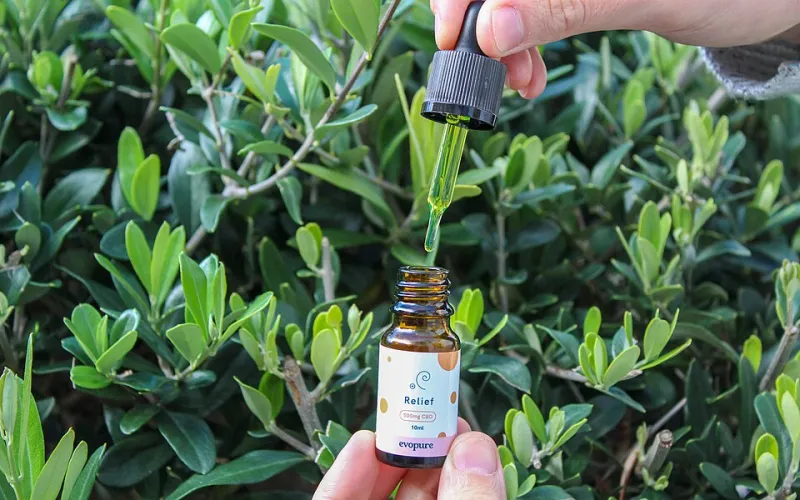
But you do not drink a millilitre. You squeeze a dropper. The dose you get depends on how much oil that dropper releases in one go. A standard dropper drop is often around 0.05ml, which would put a 10% oil at roughly 5mg per drop. Another dropper might release 0.07ml, giving you about 7mg. Same label. Same bottle size. Very different drop.
Drop size is not a standard
There is no universal UK dropper specification that guarantees every 10% oil pours the same drop. Drop size can shift with the width of the dropper tip, the flexibility of the bulb, the viscosity of the oil and even the room temperature. A thicker MCT-based oil may form a larger droplet than a thinner hemp-seed oil. A cold kitchen can make the oil more syrupy. A vigorous squeeze can push out more than a gentle one.
That matters because many shoppers dose by drops. If you have settled on 'four drops' as your routine, and you switch brands, those four drops may not be the same four drops. The percentage on the front of the bottle will not warn you.
The marking problem
Some UK CBD droppers have faint markings for 0.25ml, 0.5ml, 0.75ml and 1ml. Others have none. Some markings are printed on the glass; others are moulded into the plastic and almost invisible once oil is inside. A few are, frankly, decorative.
A simple check is to fill the dropper to the 1ml line and count how many drops it takes to get there. Do it at room temperature, with the bottle upright, and repeat it a couple of times. If it takes 20 drops to reach 1ml, your average drop is about 0.05ml. If it takes 14, your drop is closer to 0.07ml. That is a big difference in dose terms, and it takes less time than reading a brand's FAQ page.
If your dropper has no markings, you can still do a rough version by counting drops into a small measuring spoon or a clean syringe. It will not be lab-grade, but it is better than assuming every dropper is identical.
Cost per drop versus cost per milligram
This is where the sums get interesting. Cost per milligram is the honest, label-based comparison. Take the bottle price and divide it by the total milligrams. A £30 bottle with 1,000mg works out at 3p per milligram. That number is useful across brands because it ignores dropper theatrics.
Cost per drop is different. It tells you what one squeeze costs, but only if you know the drop volume. Using the same £30 bottle: at 0.05ml per drop, you get 5mg per drop, so each drop costs about 15p. At 0.07ml per drop, you get 7mg per drop, so each drop costs about 21p. The bottle has not changed. The price per milligram has not changed. But your cost per drop has jumped by 40%.
That is why a bottle that feels 'weak' because you need more drops may still be better value per milligram, while a bottle that pours fat drops may feel stronger but empty faster. Neither is automatically the better buy. You just need to know which sum you are doing.
A five-minute bottle audit
Before you commit to a repeat purchase, run a few checks:
- Look for total CBD in milligrams, not just the percentage. A 10ml bottle at 10% has about 1,000mg; a 30ml bottle at 5% has about 1,500mg. The percentage alone will not tell you which is better value.
- Check whether the brand states mg per ml and mg per drop. If it does, note whether that is measured or estimated.
- Inspect the dropper. Are the markings clear? Do they match the instructions? Can you count drops to 1ml?
- Note the carrier oil. MCT and hemp-seed oils can behave differently in the dropper, and that affects drop size.
- Compare cost per milligram first. Then, if drop size is stated or measurable, compare cost per drop.
Questions worth asking before you buy
A good UK CBD brand should not be spooked by a short email. Ask:
- What is the approximate drop volume of your dropper in millilitres?
- How many milligrams of CBD are in a single drop at this strength?
- Is the dropper calibrated or marked to a specific volume?
- Is the percentage shown weight by volume or weight by weight?
- Can you share the batch certificate of analysis for the oil I would receive?
If the answers are vague, that does not automatically make the product bad. But it does mean your dose is more guesswork than it needs to be. And if a brand is happy to sell you a 10% oil but cannot tell you what a drop contains, treat the dropper as a starting point rather than a prescription.
The best UK CBD value is not always the biggest percentage on the shelf. It is the bottle whose dropper you actually understand. Count the drops, check the milligrams and do the maths before you reorder. Your future self, squinting at a half-empty bottle, will thank you.
This is consumer arithmetic, not medical advice. If you are using CBD for a health reason, speak to a healthcare professional.