The Leftover Milligram: What Your UK CBD Bottle Never Actually Pours
Here's a quick test. Take the empty CBD bottle from your kitchen cupboard, the one you finished last month, and hold it up to the light. There's a brown smear on the glass, isn't there? A ring around the shoulder. Maybe a little pool in the corner you keep tilting towards the light like you're panning for gold.
That's not you being sloppy. That's dead volume, and you paid for it.
Where the missing millilitres actually go
Nobody's hiding anything — glass is just glass. But three losses stack up on every bottle:
- The film on the walls. Viscous oil clings. A 10ml amber bottle keeps roughly 0.2–0.4ml on its inner surface once you've emptied it, and no amount of shaking gets that back.
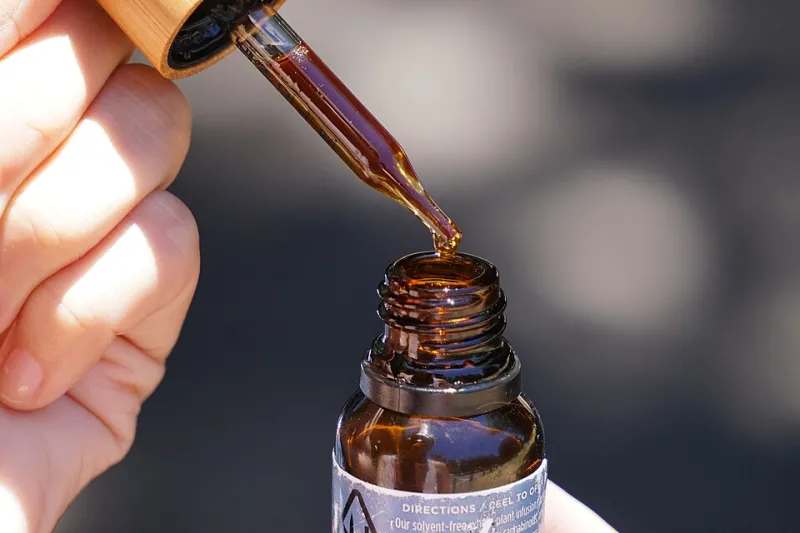
- The reach problem. This is the big one. A dropper stem that stops 10–15mm short of the base leaves a pool the pipette simply cannot touch. Tip the bottle to 45 degrees and you can chase some of it, but you're still leaving somewhere between 0.4ml and 1.2ml behind depending on how wide the shoulder is.
- Pipette residue. Every draw leaves a coating inside the tube. It's small per squeeze — think 0.02–0.05ml — but across 25 or 30 doses it quietly becomes a millilitre.
Add those together and a typical 10ml bottle gives you somewhere between 7.9ml and 9ml of oil you can actually dose with. Nothing illegal, nothing sinister. Just a number that isn't the number on the front of the bottle.
The label hasn't got room for this
UK CBD branding is tightly constrained — novel food authorisation, the 1mg-per-container THC limit, all the regulatory scaffolding you'd hope for. Dead volume isn't part of it. Fill quantity has its own rules: under the weights and measures average system, a 10ml bottle is allowed a tolerable negative error of roughly 9 per cent on an individual unit. So 9.1ml can still be sold as 10ml.
Combine the legal floor with a badly designed bottle and you're looking at around seven millilitres of doseable oil in something sold as a ten. That's a 30 per cent haircut before you've even argued about whether 1,000mg on the label means 1,000mg in the bottle.
Two bottles, same strength, different maths
Let's make it concrete. Two 10ml bottles, both labelled 1000mg, both full-spectrum, both from brands you'd recognise on a Holland & Barrett shelf.
| Bottle X | Bottle Y | |
|---|---|---|
| Price | £30.00 | £29.00 |
| Stem reaches base? | Yes | No — stops ~12mm short |
| Estimated dead volume | 1.0ml | 2.1ml |
| Usable oil | 9.0ml | 7.9ml |
| Usable CBD | ~900mg | ~790mg |
| Cost per label mg | 3.0p | 2.9p |
| Cost per usable mg | 3.33p | 3.67p |
Bottle Y looks like the bargain. It isn't. You saved a pound at checkout and bought about 110mg less CBD. Per milligram of oil that actually comes out of the dropper, Y is roughly 10 per cent worse value.
Now scale up. A 30ml bottle with a stem that touches base might lose 1.6ml total — the same absolute loss spread across three times the oil. Cost per usable milligram drops to around 2.4p on a £69, 3000mg bottle. Bigger bottles aren't just cheaper per milligram on the sticker; they're cheaper per milligram after the losses, because dead volume doesn't scale with fill size. A fixed 1.5ml of cling is 5 per cent of a 30ml bottle and 15 per cent of a 10ml one.
The dropper markings deserve a mention
Those little etched lines — 0.25ml, 0.5ml, 0.75ml, 1ml — are aspirational. They tell you where the oil column sits in a clean, warm, thin liquid. CBD in MCT is neither thin nor reliably warm, and a wide-bore pipette draws less than a narrow one for the same suction. Squeeze a bit too gently and you get an air gap; squeeze hard and you get bubbles.
We're not suggesting anything dishonest here. Graduated pipettes are approximations everywhere, from labs to kitchen cupboards. But if you dose by counting to the 0.5ml line and assume that's 0.5ml, you're probably running 5–10 per cent light, on top of the dead volume. Two small errors, both invisible, both compounding.
A practical checklist before you buy
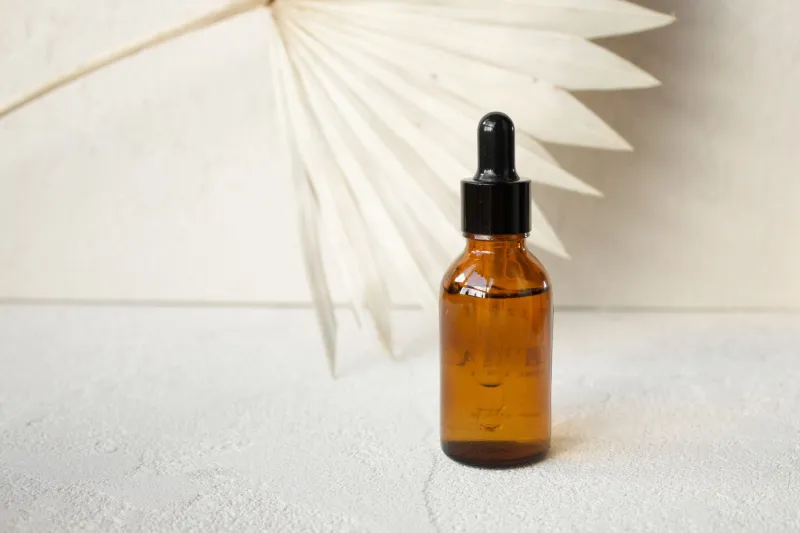
Do the stem maths. Product photos usually show the dropper beside the bottle. If the stem looks shorter than the bottle is tall, the last few millimetres are gone. Glass stems that reach the base beat short plastic ones.
Watch the shoulder. Fat, square-shouldered bottles look premium and trap oil in four corners. A simple straight-sided or gently tapered amber bottle loses less.
Check the fill. Some brands print the fill volume on the base or the batch label. A 10ml bottle marked as containing 10ml of oil is fine; one marked 9.5ml tells you the brand knows the difference.
Read the last paragraphs of reviews. Search for "last few doses" or "couldn't get it all out". This is where shoppers tell the truth that marketing won't.
Favour bigger bottles if you're a regular. If you go through a bottle a month, a 30ml format cuts dead volume as a proportion of what you buy — as long as you'll finish it before the oil oxidises.
Getting the last few doses out
You can recover a bit. Stand the bottle upright between uses rather than leaving it on its side. Warm it briefly in a mug of hot tap water — five minutes, not boiling — to thin the oil and let it pool. When it gets stubborn, tip the remainder into a small clean 5ml bottle so the pipette has less empty space to fight. A £3 spray of food-grade amber glass goes a long way.
But the honest answer is that the last drop is a design decision made in a factory, not something you can fix in your kitchen. Compare bottles on cost per usable milligram, look at the stem before you look at the strength, and treat the number on the front as a starting point rather than a promise.